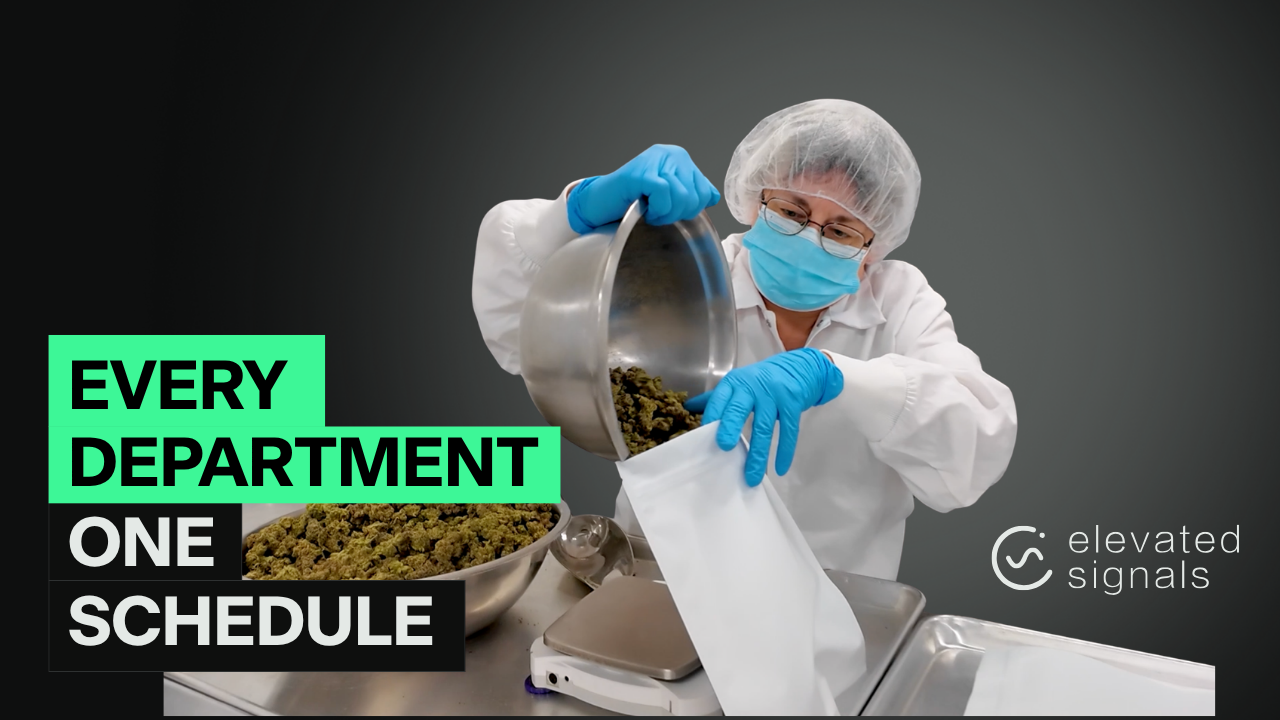

A QA hold pushes a release date. An export to Germany gets approved on a Wednesday afternoon. A trim batch comes in two days early. None of these are unusual for a cannabis facility - it's just another day.
The real test of your production schedule isn’t how it looks Monday morning. It’s what happens when something changes mid-week. And in cannabis, something almost always does.
For most cannabis producers, the schedule today lives across a whiteboard, a spreadsheet, and a group chat. That works, until the moment it has to absorb a change. Then the whiteboard is in the wrong room, the spreadsheet hasn’t been updated yet, and the message in Teams reaches some people in five seconds and others not at all. The team you’re paying for spends the next hour re-aligning instead of running production.
What any cannabis production schedule needs to do when the plan changes
Three things separate the schedules that survive change from the ones that don’t.
1. Change has to propagate without anyone forwarding it. When something shifts mid-week, the rest of the team has to find out without anyone remembering to send a message. If a schedule update depends on a supervisor catching it in Teams or passing it along at shift change, the race is already lost. The right pattern: change propagates automatically. No phone tree. No “did you see my message?”
At Safari Flower Co., a Fort Erie–based EU-GMP cannabis processor exporting to Germany, the UK, and Australia, a recent export approval came in on short notice. Their schedule absorbed it in real time:
“I can see that data happen live and not have to wait for somebody to come tell me in person. I get all these notifications directly through our planning schedule.” - Cody Moses, Material Handler, Safari Flower Co.
2. Every team has to be working from the same view. If post-harvest is looking at one version of the schedule, QA is looking at another, and inventory hasn’t checked since this morning, alignment is impossible. The schedule has to live in one place: visible across departments, traceable lot by lot, with no question about which version is current.
Safari Flower’s Inventory Supply Chain Manager, Jordan Riddle, named the gap directly:
“A really big bottleneck previously was departmental alignment within our facility. We were always kind of relying on word of mouth. There was no actual structured schedule to refer to.” - Jordan Riddle, Inventory Supply Chain Manager, Safari Flower Co.
3. Leadership has to see further than today’s schedule. Day-to-day visibility solves operator coordination. But the bigger cannabis production decisions, like when to ramp final packaging, where the next constraint will hit, or how to staff for an export window, happen at a higher altitude. The schedule has to surface that wider view too, not just the next 24 hours.
Safari Flower’s CEO, Brigitte Simons, on what shifts when leadership gets that lens:
“The scheduling module is unlocking capabilities for us to be more efficient and communicate more widely across departments, rather than teams chats or emails. It allows us to look at final packaging activities from a larger global sense and get groups in line with that schedule.” - Brigitte Simons, CEO, Safari Flower Co.
The shift, in practice
When a cannabis facility moves from word-of-mouth coordination to a live shared schedule, the differences show up in the texture of the day, not just the dashboards:
✅ Mornings start with the schedule. Not with chasing down what changed overnight.
✅ Last-minute pivots get absorbed. Instead of triggering a phone tree.
✅ Cross-department updates replace. The “I didn’t know that was happening today” conversation.
✅ Audit trails come along for free. Every schedule change is logged in the same system as the work itself.
Scheduling first. Planning next.
There’s a natural sequence here. Most cannabis producers start with production scheduling, the live shared view that solves today’s coordination chaos when plans change. From there, they graduate to forward-looking production planning (capacity modeling, demand forecasting, multi-week resource allocation) once that foundation is in place.
That’s the path Safari Flower is on, and it’s the path the broader Elevated Signals Planning & Scheduling product is built to support: scheduling that gets your team on the same page now, with planning capabilities that come into play as your operation scales.
Cannabis production scheduling FAQ
How do licensed cannabis producers handle last-minute schedule changes?
The leading cannabis producers we work with use real-time scheduling software so that schedule changes propagate instantly across departments. When an export gets approved at the last minute or a QA hold pushes a release date, the rest of the operation sees the change immediately, without phone calls or chase emails.
What’s the difference between production scheduling and production planning for cannabis producers?
Production scheduling is the live, day-to-day operating layer: the shared view of what’s running, what’s queued, what just changed. Production planning is the forward-looking layer: capacity modeling, demand forecasting, multi-week resource allocation. Most cannabis producers feel scheduling pain first, and adopt scheduling before they layer in planning.
Can a whiteboard or spreadsheet schedule meet Health Canada or EU GMP requirements?
On their own, no. Whiteboards and spreadsheets don’t preserve a record of who changed what, when, or why. For Health Canada compliance and EU GMP audits, your cannabis production schedule needs to live in a system that maintains a traceable history of every change.
See live production scheduling in action
Explore Elevated Signals’ Planning & Scheduling for cannabis producers or read the full Safari Flower Co. story

.png)



%20(1).png)
.png)
%202.png)